Losing teeth changes more than your smile. It can affect how you eat, how clearly you speak, and how confident you feel in everyday moments. When people start comparing dental implants vs dentures, they are usually not just choosing a treatment – they are trying to get back comfort, function and peace of mind.
There is no single right answer for everyone. Some patients want the closest thing to a natural tooth. Others need a more affordable option now, or a solution that works well with their health, bone support or lifestyle. The best choice depends on your mouth, your priorities and your budget.
Dental implants vs dentures: the basic difference
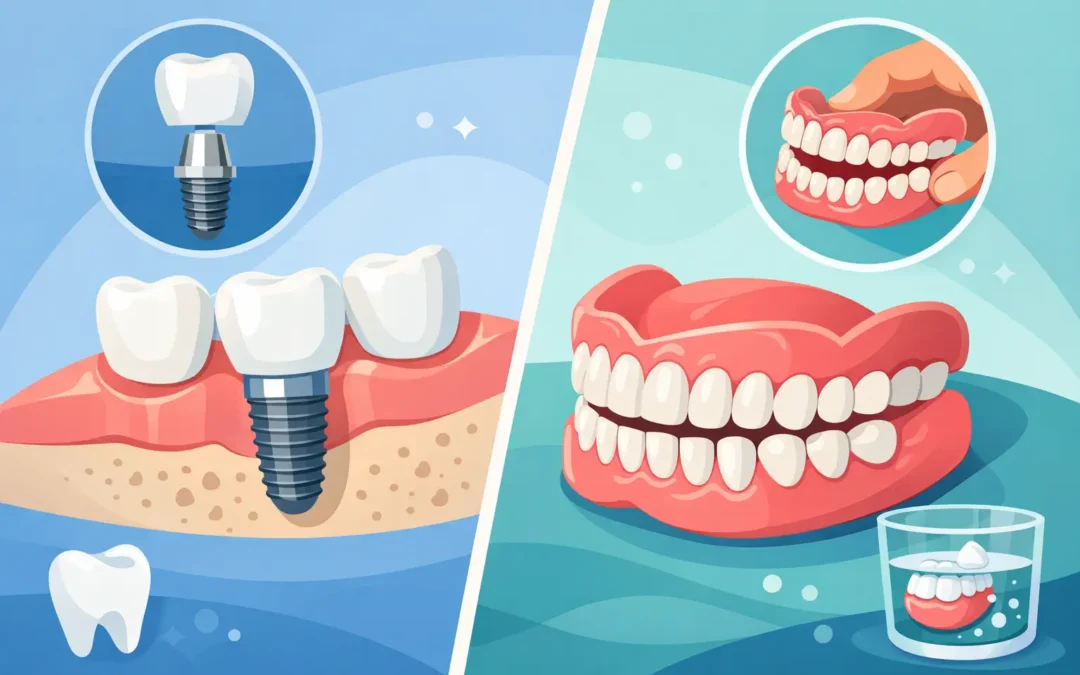
Dental implants are small titanium posts placed into the jawbone to replace missing tooth roots. Once healed, they support a crown, bridge or even a full arch of replacement teeth. Because they sit in the bone, they are designed to feel stable and secure.
Dentures are removable appliances that replace missing teeth and nearby gum tissue. They can replace a few teeth or a full set. Traditional dentures rest on the gums rather than being fixed into the jaw.
That core difference matters. Implants aim to mimic natural teeth more closely, while dentures provide a removable replacement that can restore appearance and basic chewing function at a lower upfront cost.
How they feel day to day
For many people, comfort is the biggest deciding factor. Dental implants generally feel more like natural teeth because they are fixed in place. You do not remove them at night, and you do not need to worry about them shifting while talking or eating.
Dentures can still work very well, but they take an adjustment period. In the early weeks, they may feel bulky or unfamiliar. Some patients notice rubbing, sore spots or movement, especially with lower dentures. This does not mean dentures are a poor option – only that they often need fine-tuning and a little patience.
If you are already anxious about dental treatment, this trade-off can matter. Some people feel more relaxed knowing dentures are non-surgical. Others feel more confident with implants because they offer a firmer, more natural feel once treatment is complete.
Eating and speaking with implants or dentures
Most patients ask the same practical question first: will I be able to eat normally again?
Implants usually provide stronger biting force and better stability. That makes it easier to chew foods like apples, meat and crusty bread. Because they are anchored in the jaw, they do not move about under pressure in the same way dentures can.
Dentures improve chewing compared with having missing teeth, but they do have limits. Hard, sticky or chewy foods can be more difficult, particularly with full dentures. Some people adapt very well and manage a wide range of foods. Others prefer to avoid anything that may dislodge or strain the denture.
Speech can also take a little adjustment with dentures. Certain sounds may feel awkward at first until the tongue and cheeks adapt. Implants tend to interfere less with speech because they stay fixed and have a lower profile.
Appearance and confidence
Both options can improve the look of your smile. A well-made denture can restore facial support and replace gaps attractively. Modern dentures can look natural, especially when carefully fitted.
Implants often have an edge when it comes to realism and confidence. They emerge through the gum more like natural teeth, and because they are fixed, many patients feel less self-conscious in social settings. There is no concern about removing them, adhesive slipping, or the teeth shifting while laughing or eating.
That said, confidence is personal. Some patients feel immediate relief simply having teeth again, whatever the method. The right result is the one that helps you feel comfortable and able to get on with life.
Cost now versus value over time
This is where the decision often gets real. Dentures usually cost less upfront than implants, which is why they remain a common and practical option. If you need to replace several teeth or a full arch and need a more budget-friendly start, dentures may be the more realistic path.
Implants usually involve a higher initial investment. There may be consultation costs, imaging, surgery, healing time and the final restoration. For some patients, that number can feel out of reach at first.
But upfront price is only part of the picture. Dentures may need adjustments, relines or replacement over time as the shape of the gums and jaw changes. Implants, while more expensive initially, can offer stronger long-term value because of their durability and stability.
It depends on what matters most to you right now. Some people need the most affordable treatment available today. Others are thinking in terms of long-term comfort and maintenance. A good dentist will talk you through both, clearly and without pressure.
Bone loss and long-term oral health
One of the biggest clinical differences in dental implants vs dentures is what happens under the gums.
When a tooth is lost, the jawbone in that area no longer gets stimulation from the tooth root. Over time, the bone begins to shrink. Dental implants help stimulate the bone in a similar way to natural roots, which can slow this loss and help preserve facial structure.
Dentures do not provide that same stimulation. As the jaw changes shape, dentures can become looser and may need to be adjusted or remade. This is especially common with lower dentures.
That does not mean dentures are harmful. It simply means they do not protect the jawbone in the same way implants can. If preserving bone is a major priority, implants often have a clear advantage.
Who is a good candidate for each?
Implants can be an excellent option if you are in good general health, have healthy gums and enough jawbone support, or are suitable for bone grafting if needed. They suit patients who want a fixed, long-term solution and are comfortable with a surgical procedure.
Dentures may be better suited to patients who want a non-surgical option, need to replace many teeth affordably, or have health or bone considerations that make implants less suitable. They can also be a good interim step while planning future treatment.
Age on its own is not usually the deciding factor. We see younger adults choose dentures because of budget, and older adults choose implants because they want better stability. The real question is whether the option matches your oral health, expectations and circumstances.
What treatment involves
Getting dentures is generally faster. After impressions and measurements, the denture is made and fitted, then adjusted as needed. There can still be a settling-in period, but the process is relatively straightforward.
Implants take longer. First comes assessment and planning, then implant placement, then healing while the bone bonds to the implant. After that, the final tooth or teeth are attached. In some cases the timeline is shorter, but in many cases it takes a few months from start to finish.
For patients who are busy, nervous or dealing with urgent tooth loss, this timing can be important. Fast is not always better, and longer is not always worse. It simply helps to know what the road ahead looks like.
Maintenance and everyday care
Implants need good brushing, flossing and regular dental reviews, much like natural teeth. They do not get decay, but the surrounding gums and bone still need care. Poor cleaning can lead to complications.
Dentures need cleaning too, just in a different way. They should be removed, cleaned properly and stored as advised. The gums and any remaining teeth also need ongoing care. Because the fit can change over time, regular check-ups matter.
Neither option is maintenance-free. The better choice is often the one you feel confident you can look after well.
So, which one should you choose?
If you want the most natural feel, stronger chewing power and a fixed solution, implants are often worth serious consideration. If you want a lower-cost, non-surgical way to replace missing teeth and restore your smile sooner, dentures can be a very good option.
Sometimes the answer sits somewhere in the middle. Implant-supported dentures, for example, combine the lower bulk of a denture with the extra stability of implants. That can be a helpful compromise for patients who want better retention without the cost of replacing every tooth with an individual implant.
At Relax Dental, these conversations are never one-size-fits-all. The right plan should feel manageable, clearly explained and tailored to your comfort as much as your teeth.
If you are weighing up your options, the most helpful next step is not guessing – it is having a calm, honest discussion about what will work best for your mouth, your budget and your day-to-day life.