If you’re weighing up Invisalign vs braces adults often ask the same few questions first – which is less noticeable, which hurts less, and which will fit real life better. For most adults, the answer is not just about straight teeth. It’s about work, confidence, comfort, budget, and whether treatment will feel manageable from day one.
A lot of adults put orthodontic treatment off for years because they assume it will be awkward, expensive, or too disruptive. The good news is that both braces and Invisalign can create excellent results. The better news is that you do not need a one-size-fits-all answer. What works best depends on your teeth, your routine, and how much flexibility you want during treatment.
Invisalign vs braces for adults: the main difference
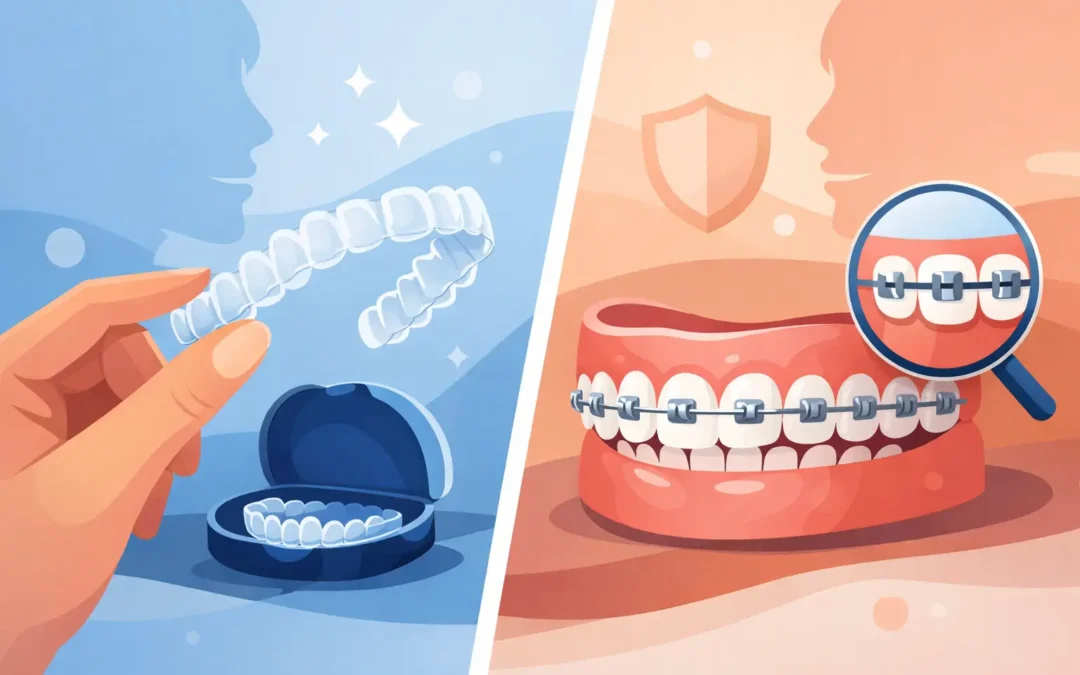
At the simplest level, braces are fixed to your teeth and move them continuously over time. Invisalign uses a series of clear removable aligners that are changed regularly as your teeth shift.
That difference sounds straightforward, but it affects nearly everything else. Braces stay on all day and all night, so you do not need to remember to wear them. Invisalign gives you more freedom because you can remove the aligners to eat, brush, and for special occasions, but that freedom comes with responsibility. If you do not wear them for the recommended hours, treatment can slow down or become less effective.
For many adults, the decision comes down to this question: would you rather have a treatment that is fixed and predictable, or one that is discreet and flexible but requires discipline?
Appearance matters more than most adults admit
There is no point pretending looks do not matter. For many working adults, parents, or people returning to dating, appearance plays a big part in the decision.
Invisalign is usually the more discreet option. The aligners are clear, and at a glance many people will not notice them. If you spend a lot of time in meetings, on video calls, or talking with clients, that can be a real advantage. Adults who have felt self-conscious about orthodontics often prefer Invisalign for this reason alone.
Braces are more visible. Even with more subtle options, they are still attached to the front of the teeth and tend to be noticed. Some adults are perfectly comfortable with that. Others feel it would affect their confidence at work or socially.
Still, appearance should not be the only factor. The least visible option is not automatically the best one if your teeth need more complex movement.
Comfort and day-to-day wear
Both Invisalign and braces can cause pressure and tenderness, especially after adjustments. That is normal. Teeth need gentle force to move. The experience, however, feels a little different.
Braces can irritate the inside of the lips and cheeks, particularly in the early stages. Wires and brackets may rub, and food can get trapped around them. Some people adjust quickly, while others find the first few weeks frustrating.
Invisalign aligners are smoother, so they often feel gentler on the soft tissues of the mouth. Many adults like that there are no brackets or wires to catch. But aligners are not pain-free. When you switch to a new set, your teeth can feel tight or sore for a day or two.
If you already feel nervous about dental treatment, comfort can matter a lot. A calm, well-explained treatment plan usually makes the whole process feel easier, whichever option you choose.
Eating, cleaning, and everyday convenience
This is one of the biggest practical differences.
With braces, certain foods are harder to manage. Sticky lollies, hard foods, and anything likely to damage a bracket may need to be avoided. Cleaning also takes more time because you need to brush carefully around the brackets and wires.
With Invisalign, you remove the aligners before eating and drinking anything other than water. That means no food restrictions in the same way. You can still enjoy crunchy apples, popcorn, or a nice dinner out without worrying about damaging brackets. Brushing and flossing are also more straightforward because there is nothing fixed to the teeth.
The trade-off is routine. You need to take the aligners out, keep them safe, clean them properly, and put them back in promptly. Adults with busy schedules sometimes love that flexibility. Others find it annoying after the novelty wears off.
Which works faster?
There is no honest universal winner here.
Some Invisalign cases move along efficiently, especially mild to moderate crowding or spacing issues. Some brace cases are faster, particularly when more detailed tooth movement is needed. Treatment time depends on the complexity of your bite, how your teeth respond, and how closely instructions are followed.
Braces have one clear advantage in compliance. Because they are fixed, they keep working. Invisalign only works when it is worn as directed. If aligners are left out too often, treatment can drag on.
So if you are wondering which is faster, the better question is which option you are most likely to stick with properly.
Invisalign vs braces adults compare on cost
Cost is often one of the first concerns, and fairly so. Adults usually have to fit treatment around rent or a mortgage, school costs, bills, and everything else life throws at them.
The price difference between Invisalign and braces varies depending on the complexity of the case and the length of treatment. Invisalign can sometimes cost more, particularly for advanced treatment plans, but not always. Traditional braces are often seen as the more budget-friendly choice, though this is not guaranteed in every case.
What matters more than the headline fee is understanding the full picture. Ask what is included, whether reviews and retainers are part of the cost, and whether there are flexible payment options available. A treatment that seems cheaper upfront can feel less affordable if the payment structure does not suit your household budget.
For many patients, affordability is not about finding the lowest number. It is about finding a plan that feels realistic and sustainable.
When braces may be the better choice
Braces are often a strong option for adults with more complex orthodontic issues. If teeth need significant rotation, vertical movement, or bite correction, fixed braces may give your dentist more control.
They can also suit adults who know they are unlikely to remember aligners consistently. If you are juggling work, children, errands, and a hundred mental tabs at once, a treatment that stays in place can remove one daily worry.
There is also something reassuring about braces for some patients. Because they are always on, there is less room for second-guessing whether you are doing enough.
When Invisalign may be the better choice
Invisalign often suits adults who want a discreet treatment option and are confident they can follow the routine. It can be a very good fit for professionals, people in public-facing roles, and anyone who wants orthodontic treatment to be less obvious.
It also appeals to adults who value being able to eat normally and clean their teeth with less hassle. If convenience around meals and oral hygiene matters to you, clear aligners can make treatment feel more manageable.
For mild to moderate alignment concerns, Invisalign can be an excellent solution. The key is having a proper assessment rather than assuming every case will suit aligners.
The best choice depends on your teeth and your habits
This is the part many comparison articles skip. The best treatment is not just the one with the nicest features on paper. It is the one that matches both your clinical needs and your personality.
If you want something subtle and flexible, and you are the sort of person who follows routines well, Invisalign may be ideal. If you would rather not think about taking aligners in and out or tracking wear time, braces may be the more practical path.
A good dental team should talk you through the trade-offs clearly, not pressure you towards the flashiest option. At Relax Dental, that kind of calm, tailored advice matters because adults often feel more comfortable making decisions when they understand exactly what to expect.
Questions worth asking at your consultation
Before choosing between Invisalign and braces, ask how complex your case is, how long treatment is likely to take, what the total cost includes, and what level of maintenance each option will require from you. It is also worth asking what happens if something breaks, if you lose an aligner, or if treatment needs refinement.
These are not small details. They shape how easy treatment feels over months, not just during the first appointment.
Straightening your teeth as an adult is not about vanity. It can be about confidence, comfort, easier cleaning, and finally dealing with something that has bothered you for years. The right option is the one that feels achievable, suits your life, and helps you move forward without added stress.