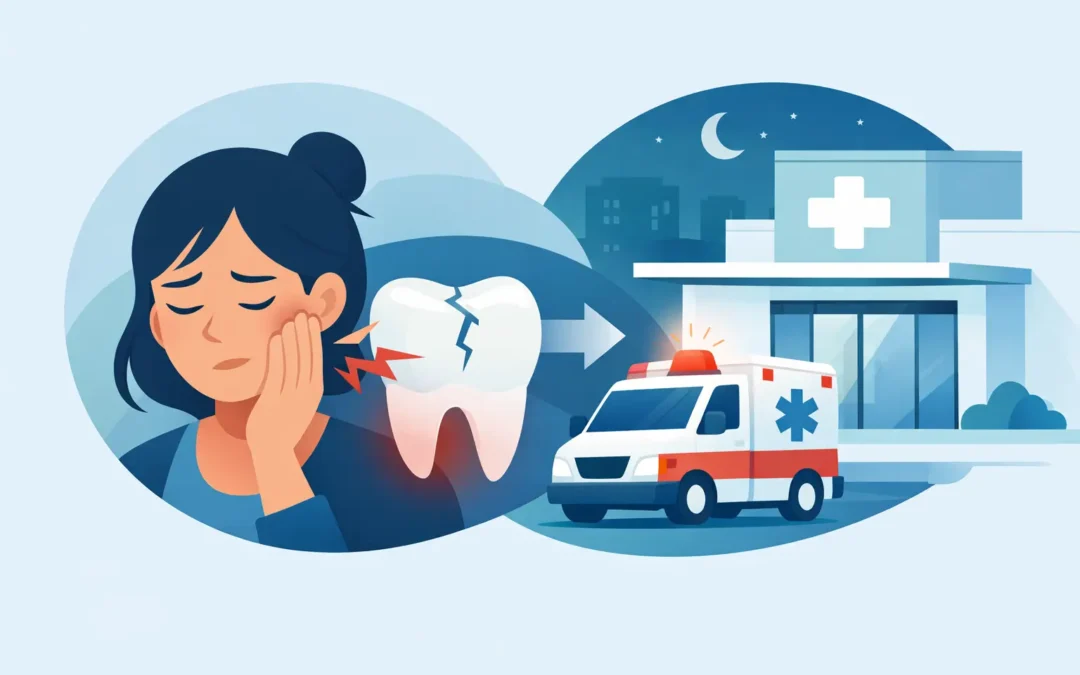
A sudden tooth problem can feel alarming fast. If you are in severe pain, bleeding, or dealing with swelling that seems to be getting worse by the hour, it is completely reasonable to wonder when should you go to ER for dental emergencies and when a dentist is the better first step.
The short answer is this: most dental emergencies are best treated by a dentist, not a hospital emergency department. But there are a few situations where the ER is absolutely the right place, especially if your breathing, swallowing, or overall safety could be at risk.
When should you go to ER for dental emergencies?
Go to the ER if a dental problem involves a medical emergency, not just a tooth problem. That includes facial swelling that is spreading quickly, trouble breathing, trouble swallowing, heavy bleeding that will not stop, a high fever with swelling or signs of infection, or a serious injury to the face or jaw after an accident.
Hospitals can help stabilise dangerous symptoms, manage serious infection, control bleeding, and assess trauma. What they usually cannot do is provide full dental treatment such as a filling, root canal, crown, or definitive repair for a broken tooth. That is why many people end up needing a dentist afterwards anyway.
If you are unsure, it helps to think about one question: is this uncomfortable, or is it potentially dangerous? Severe dental pain can be miserable, but danger signs like swelling near the throat, uncontrolled bleeding, or trauma to the jaw shift it into ER territory.
Signs your dental emergency should not wait for a dentist alone
Swelling that affects breathing or swallowing
This is one of the clearest reasons to go straight to the ER. An infection from a tooth or gum can sometimes spread into the face, jaw, or deeper tissues. If your cheek is swollen and getting larger quickly, or you feel tightness in your throat, difficulty swallowing, or shortness of breath, do not wait.
Even if the problem started as a toothache, once swelling begins to affect your airway or ability to swallow, it becomes a medical emergency. You need urgent assessment as quickly as possible.
Uncontrolled bleeding
Some bleeding after a tooth injury, extraction, or gum trauma can happen. But if blood is flowing heavily, soaking gauze repeatedly, or not easing with firm pressure, that is different.
A good rule of thumb is to apply steady pressure with clean gauze or a clean cloth for 10 to 15 minutes. If the bleeding remains heavy or you feel faint, go to the ER. This matters even more if you take blood-thinning medication or have a condition that affects clotting.
Fever and facial swelling
A dental infection does not always stay localised. If you have a swollen face along with fever, chills, feeling weak, or increasing pain, the infection may be spreading. The same applies if you notice pus, a foul taste in your mouth, or swelling under the jaw.
In that situation, same-day dental care is important, but the ER may be the safer choice if the swelling is significant, you are unwell overall, or the infection appears to be progressing quickly.
Jaw injury or facial trauma
If you have been hit in the face, fallen, or had a sports injury and you suspect a broken jaw, go to the ER. Warning signs include severe pain when moving your jaw, difficulty opening or closing your mouth, teeth that suddenly do not meet properly, numbness, or obvious facial deformity.
The same applies if a tooth injury is part of a larger accident involving your head, neck, or face. A dentist can help with the teeth, but hospital assessment comes first when there may be fractures or other trauma.
Dental problems that usually need a dentist, not the ER
This is where many people get stuck. A lot of urgent dental issues feel dramatic and painful, but they still usually belong in a dental chair rather than a hospital.
A severe toothache, a cracked tooth, a lost filling, a broken crown, a knocked-out tooth, a dental abscess without airway symptoms, or a chipped tooth normally needs a dentist as the first call. These problems often need dental tools, dental imaging, and treatment that an emergency department does not routinely provide.
For example, if a tooth is knocked out, time matters. A dentist is usually the best person to try to save it. Pick the tooth up by the crown, not the root, gently rinse it if it is dirty, and if possible place it back in the socket. If that is not possible, keep it in milk or inside the mouth between the cheek and gum and get urgent dental care straight away.
Likewise, a painful abscess often needs drainage or treatment of the tooth itself. The ER may help with pain relief or antibiotics if needed, but the underlying dental cause still needs proper dental care.
It depends on the timing, severity, and your symptoms
There is some grey area, and that is where people often feel uncertain. A bad toothache at 11 am on a weekday is different from rapidly worsening swelling at midnight. A chipped tooth is not the same as a deep fracture exposing the nerve. Mild swelling is not the same as swelling spreading toward the eye or throat.
If you can breathe normally, swallow normally, and the bleeding is controlled, an emergency dentist is often the right place to start. If your symptoms are escalating, affecting your ability to function, or making you feel systemically unwell, the ER becomes more appropriate.
Children, older adults, pregnant women, and people with compromised immune systems may need a lower threshold for urgent medical review as well. Infections and injuries can become more serious more quickly in some patients.
What the ER can and cannot do for dental emergencies
It helps to know what to expect. The ER is designed to manage urgent medical risk. They can assess swelling, treat dehydration, control serious bleeding, provide pain relief, prescribe medication when appropriate, and investigate major facial trauma.
What they usually cannot do is complete the dental treatment that fixes the source of the problem. They are not typically set up to restore a broken tooth, complete a root canal, replace a lost filling, or re-cement a crown.
That is why going to hospital for a non-life-threatening dental issue can sometimes leave patients frustrated. You may spend hours waiting, only to be told to follow up with a dentist the next day. If the problem is dental rather than medical, a dental clinic is often faster, more targeted, and more cost-effective.
When should you call an emergency dentist first?
Call an emergency dentist first if you have a knocked-out or broken tooth, severe dental pain, swelling that is local but not affecting breathing, a lost filling or crown, a gum infection, or a suspected abscess without major facial swelling.
A good emergency dental team can tell you quickly whether you should come in urgently or head straight to the ER instead. That guidance can make a stressful moment feel much more manageable. At a gentle, patient-focused practice such as Relax Dental, that sort of calm triage matters just as much as the treatment itself.
What to do while you are waiting for help
Try to stay calm and keep the area clean. Rinse gently with warm salty water if your mouth is sore or swollen. Use a cold compress on the outside of your cheek for swelling. If there is bleeding, apply firm pressure with gauze or a clean cloth. If a tooth has been knocked out, handle it carefully by the crown.
Avoid putting aspirin directly on the gum or tooth, as this can irritate the tissue. If you take pain relief, follow the packet directions and avoid exceeding the recommended dose. If symptoms start to worsen while you are waiting, especially swelling, fever, or breathing difficulty, do not keep waiting. Seek urgent medical help.
The safest way to decide
If a dental emergency is painful but localised, a dentist is usually your best first call. If it involves your airway, major bleeding, fever with swelling, or serious facial injury, go to the ER.
You do not need to make a perfect decision under pressure. You just need to recognise when a tooth problem has become a health problem. If something feels like it is moving beyond the mouth and affecting your breathing, swallowing, safety, or general condition, trust that instinct and get urgent care. A calm response now can prevent a much bigger problem later.